Historic Almanac Forecasts a Snowier Winter — and a Harsh Climate for its Own Future

                                                                                                                                  JONATHAN M. PITTS                                                                                                                                P UBLISHED:December,2025 


Chad Merrill, the Hagerstown Almanack’s weather prognosticator, stands for a portrait near his home. Merrill uses his knowledge of meteorology to study weather patterns and climate to predict the weather for the coming year. (Surya Vaidy/Staff)                                                                      

A beloved periodical that has been in continuous operation since John Adams waspresident is calling for more snowfall in Maryland this winter than last — and decreasing chances of remaining in business.

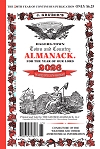
The Hagers-Town Town and Country Almanack, an annual journal known for its blend of long-range weather forecasts, astrological predictions, and nuggets of homespun wisdom, has published its 2026 edition, its 230th.
The 82-page magazine is calling for chillier temperatures and a potential end to a four-year snow drought in the mid-Atlantic region, including in Maryland. It has also served up its usual treasure-trove of gardening, livestock and housekeeping tips. 

But already, strong headwinds against the almanac genre have stiffened over the past five years. One of its best-known cousins, the beloved Farmerʼs Almanac, announced last month that its 2026 edition — the 208th of its long life — will be its last.

The demise of that widely read periodical leaves only a handful of almanacs still operating in the United States and just like its Lewiston, Maine-based counterpart, the “Hagers-Town” publication more commonly referred to as the Hagerstown Almanack is struggling to stay viable on a changed media landscape.

“It’s a different environment out there; it’s not the way it used to be,” said Jerry Spessard, retired businessman and Hagerstown native who has served as business and sales manager for the Almanack, now the second-oldest in the country, since 1984. “Five years ago, I was printing 50,000 copies, and now I’m down down to 11,000. We’re working as hard as we can and hoping we can hang in there as as long as possible, but I’d say we need some kind of miracle to happen.”

The newest edition of the J. Gruber Hagers-Town Town and Country Almanack, to quote its full formal name, is available for purchase at locations at 111 locations the across the mid-Atlantic, including 37 in Maryland. (Seven are either in Baltimore or within a half-half-hour’s drive.) The cover price is $6.25.

Spessard and longtime editor Charles W. “Chad” Fisher Jr. have also committed to publishing a 2027 version of The Almanack, the business manager said, but plans beyond that are unclear. Should it meet the fate of the Farmer’s Almanac after that, it would mark the end of a historic run.

The Hagers-Town Almanack belongs to a tradition, some say, that dates back as far as ancient Babylonia, where astronomers are known to have created tables ofplanetary 1000planetary periods they were able to connect to lunar phenomena as early as 1000B.B.C.

                                           THE ALMANACK TEAM


                                  From L to R:  Chad R. Merrill, Chad Fisher, and Jerry Spessard

Over the next few centuries, astronomers and other thinkers in the Near East and Europe discerned connections between celestial patterns and such phenomena as weather variations and optimal times for harvest. Almanacs translated the practices into a literary form.

Historians say the genre took root and flourished in colonial America, where the overwhelming majority of people made their living through farming and where the weather could be changeable and harsh. A printer named John Gruber entered the field in the late 1700s. The son of German immigrants, Gruber arrived in Hagerstown in 1796 to start a newspaper for the many German settlers who lived in Western Maryland at the time. He founded The Almanack a year later, publishing it exclusively in German through 1822. “The Almanackʼs principal features were a calendar, a multiplication table, information on the sizes of the earth, moon and sun; and the mileage from Hagerstown to East Coast cities,” Bill Maharay, the former president of the Washington County (Md.) Historical Society, wrote in the Herald-Mail, a newspaper that serves the county, in 2022, adding that long-range weather forecasts were its main draw. “Added to each issue was homespun wisdom, such as: ʻEducation is a companion,
which no misfortune can depress, no crime can destroy, no enemy can alienate, no despotism can enslave.'”

A glance at the current edition shows that the format and mission havenʼt changed a great deal. In addition to “Astronomical Characters and Charts” and “Up And Down Signs of the Moon,” readers are treated to such departments as “Hints For the Homemaker,” “Best Days for Planting, Weeding & Harvesting,” and “Timely Thoughts and Reflections.”, “Back when dinosaurs existed, there used to be volcanoes that were erupting on the moon,” and “cucumbers are technically a fruit, not a vegetable,” The Almanackʼs “interesting” facts claim. “Surprisingly, hairspray removes ink from most fabrics,” another reads.  And it also contains long-range weather reports with more than 30 pages of detailed predictions for four different geographical zones. The mid-Atlantic region, which includes Maryland, Pennsylvania, Virginia, Delaware, and West Virginia, is most prominently featured. 

Their mastermind is Chad Merrill, the eighth “weather prognosticator” in the magazineʼs history. Unlike his counterparts in mainstream weathercasting, who rely on Doppler radar, satellite data and sophisticated computer software to make their forecasts just a few days in advance, Merrill keeps an eye on larger-scale meteorological phenomena — phases of the moon, faraway wind patterns, weather data accumulated over a course of decades and more — to produce his surprisingly detailed outlook more than a year in advance. Their accuracy remains open to debate. His predecessor in the job, a mathematician and computer scientist named Bill OʼToole, once said he was 57.5% accurate in his best year but Merrill said he hears somewhat regularly from the gardeners and farmers who make up most of The Almanackʼs reader base that his forecasts have helped them decide on when itʼs wisest to plant or order supplies. “The benefit to long-term forecasting … is that you can identify a particular period within a month that might feature an anomalous weather pattern, or a particular anomalous weather pattern for a part of the season,” the 45-year-old says.
Mainstream meteorologists rarely venture predictions so far in advance.

Such insights keep hardcore readers coming back, but Spessard said it has been hard to contend with an array of factors outside his control. Internet shopping has forced all but one of his former distributors out of business, for example, printing costs have skyrocketed over the past half-decade, and national store chains that once carried The Almanack, such as CVS and Walgreens,are increasingly wary of carrying regional products. In addition, the average Almanack reader is in his or her 60s or older, a demographic whose numbers sadly diminish with each passing year.
Spessard, 76, has tried working with an AI advertising platform and joining enough farm and garden-related Facebook groups to bring Almanack messaging to some 10,000 potential customers, but his efforts have had too little effect in a diverse media market. He often hears from the Almanackʼs remaining readers, he said, but the conversations can be bittersweet: most want to share stories about how the journal has been part of their familiesʼ lives dating back generations but few report that their own children or grandchildren are interested.

If all goes well this year, the magazine will clear $5,000, Spessard said, and should it slip into territory where heʼs losing money, he may have to quit his beloved avocation.  “I hope the Almanack is not an idea whose time has come and gone,” he said. Fisher sounds more optimistic. A great-great-great-great-great-grandson of John Gruber, he is proud that The Almanack has been in family hands ever since, including his own for 25 years.

And just as his own father spent many hours passing knowledge of the publication onto him, heʼs educating his adult son, Charles Fisher III, about its operations. Fisher, 76, is crossing his fingers that some former Farmerʼs Almanack subscribers will become converts, and heʼs hopeful his team will be able to find the right formula to catch the attention and the pocketbooks of younger readers and keep the legacy alive. “We do this to keep the tradition going and because we love it,” he said. “Weʼre definitely keeping the lights on for now.”